
 1 year ago
August 29, 2025August 29, 2025
Graduates of its Healthcare + Architecture program return as industry leaders
It’s hard to imagine anything more important than the design and construction of the spaces used to fix us when we’re broken. The evolution of hospitals spans centuries, beginning at the dawn of civilization and advancing in tandem with humankind: The earliest known forms of hospitals were in religious temples in ancient Greece, the Romans invented military hospitals that pioneered more organized approach to care, the Enlightenment ushered in the regular training of physicians, the Industrial Revolution brought the professionalization of healthcare and the development of a competitive market . . . and so on.
Today, hospitals are often the jewels of the cities they stand in; Gleaming towers of modern design holding technology and treatments that would have been unheard of just one generation ago. But, just as society strives to improve, our hospitals can still improve. And that’s where Clemson University’s Architecture + Health program steps into the picture.
Rethinking hospital design
“Hospitals and large medical centers are arguably the most complex building types we design and build,” says David Allison, president of the American College of Healthcare Architects and Alumni Distinguished Professor and director of graduate studies in Architecture + Health. “They are also some of the most expensive buildings on a per square foot basis, which is relatively small compared to their life cycle operating cost, given they are intense 24/7/365 operations.”
 David Allison, president of the American College of Healthcare Architects and Alumni Distinguished Professor and director of graduate studies in Architecture + Health.
Allison and colleague Anjali Joseph, endowed chair of Clemson’s School of Architecture, hosted a summit at the Madren Conference Center August 21-22 that brought together some of the country’s top thinkers in healthcare architecture, focused on applying innovative building systems in healthcare facility planning. Some of the applications included using mass timber products, like the ones developed by Clemson’s Wood Utilization and Design Institute, integrating daylighting and solar power, and modular designs that vastly improve hospital construction speed, efficiency and reliability.
Perhaps not surprisingly, many of the attendees at the event, which was sponsored by the Academy of Architecture for Health (AAH), were Allison and Joseph’s former students.
“We produce graduates who work around the globe, are leaders in some of the largest and most recognized architecture firms that practice healthcare architecture and are leaders in professional service,” says Allison, who is marking his 36th year at Clemson. “We’re the most structured and largest program of our kind in the country, so we are the anchor for this conference.”
Sustainability, efficiency, and profitability
One of the attending graduates was Graham Sinclair, who earned his degree in 2010 and now works as an associate principal medical planner for The Beck Group, an architectural and construction firm based in Dallas, Texas, founded in 1912 that builds hospitals and medical centers in multiple states.
“I like this conference because these events are usually for the owners to network, but this one is for the architects,” Sinclair said during an interview between presentations. “It’s about the innovative, out-of-the-box ideas. For instance, the last session was about heavy timber framing, which isn’t being done much in healthcare, but can provide many benefits from the patient experience to a sustainability standpoint.”
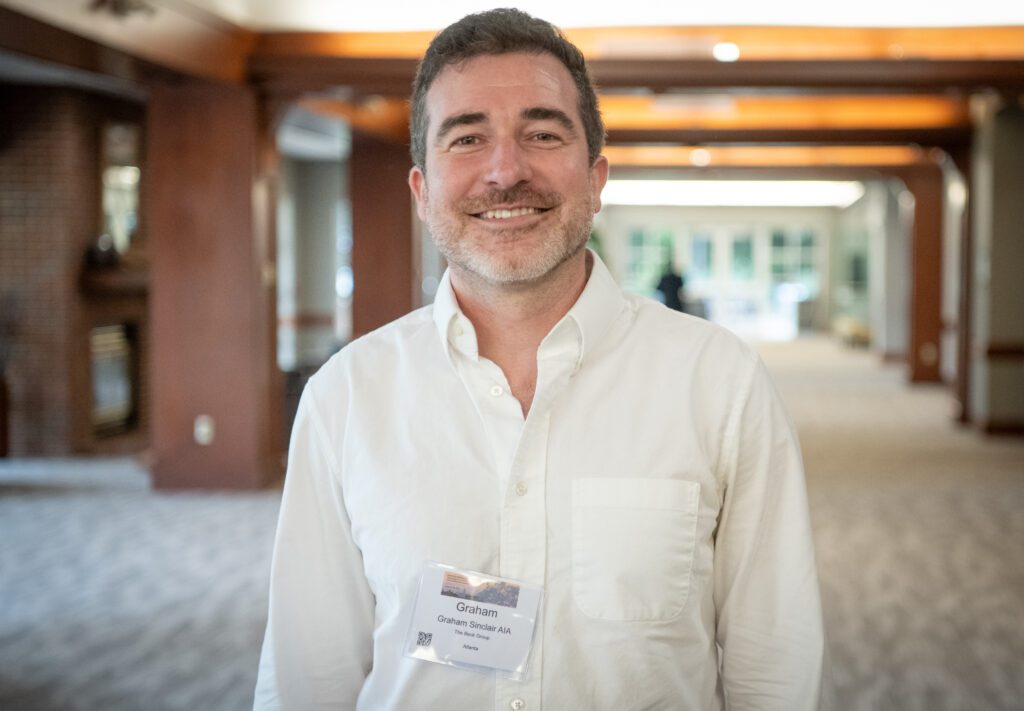 Graham Sinclair ’10
According to Allison, Sustainability is one area in which healthcare architecture can improve the most. Another is efficiency.
Ford Kellogg, CEO of Synergy Med Global Design Solutions, attended the event to network with fellow innovators and absorb some new ideas for his company, which is pioneering the use of modular healthcare rooms. His company’s Clean Cube Medical System engineers and fabricates operating and critical care rooms in controlled environments and in tandem with the construction of new hospitals, so that the rooms can simply be dropped into place as soon as the foundations are complete, not only vastly improving the efficiency of hospital construction but significantly improving the cleanliness, dependability and quality of the space.
“I met David Allison for the first time probably six or seven years ago when I first came to this event,” said Kellogg. “He is renowned in the healthcare industry as one of the prime educators of healthcare-focused architects. Over the years, I’ve met many healthcare architects who have learned to master their craft through David and his colleagues here at Clemson. The program is known for turning out the best, most forward-thinking professionals in the business.”
 Ford Kellogg, CEO of Synergy Med Global Design Solutions.
Kellogg said that Forward-thinking includes designing new hospitals to be more sustainable, efficient, sterile, adaptable and, yes, profitable. In today’s healthcare environment, most hospitals struggle to recoup operating costs, so helping the bottom line can ultimately help patients, and the most profitable room in a hospital, by far, is the OR.
“These clinical intervention spaces that my company focuses on are the largest revenue generators in a hospital,” says Kellogg. “A typical operating room takes three to six months to build. We can do parallel construction, where we’re manufacturing off-site in a controlled environment. At the same time, the slab is being poured for a surgery center or a hospital, and we can deliver that space in 18 to 24 days. The quicker you can turn that space on, the quicker you realize your revenue and pay off your debt.”
Clemson Architecture + Design alumni leading the way
Bringing dozens of ambitious subject matter experts like Kellogg and Sinclair together, where they can listen to each other and share ideas, helps push the boundaries of what healthcare architecture can be. In fact, as the conference got going, there was probably no other place on the planet where one could witness a stronger collective passion for the subject.
Between presentations, attendees would file out of the auditorium to fill the wide hallways of the Madren Center, and enthusiastic discussions would spring up all around. Subjects overheard being discussed included lowering hospitals’ carbon footprints in terms of buildings and operations, the need to be more resilient in response to the impact of severe natural disasters, using advanced finishes that don’t harbor biomedical material, and creating healthcare spaces that have greater access to daylight and connections to nature to help minimize staff burnout and turnover — an increasing concern post-COVID.

“There’s more healthcare construction going on right now than ever,” said Kellogg. “A lot of these buildings are aging and having to be replaced, and we’re having to rethink how we deliver these spaces. Everywhere I look, graduates of Clemson’s healthcare architecture program are on the front lines of that shift.”
A quick look at the Architecture + Health alumni directory confirms Kellogg’s observation. Now in its 57th year, the program sees most of its graduates awarded postgraduate fellowships and boasts alumni in dozens of the industry’s top firms.
“I chose healthcare design because it’s gratifying,” said Sinclair. “When you finish a nicely designed hospital space and see the impact it makes on the patients, the staff that work there and the community . . . it really makes me feel good about what I spend my time on.”


 English (US) ·
  Indonesian (ID) ·