
 1 year ago
The University of New Mexico recently partnered with Anchorum Health Foundation, the largest health foundation in New Mexico, to bolster the university’s 15-year-old Health Extension Regional Offices (HEROs) program.
UNM received a $330,000 grant from Anchorum to fund HEROs agents, who live and work in underserved areas of New Mexico and in Tribal communities to address social determinants of health, which include the social, economic and environmental factors that prevent people from accessing quality health care.
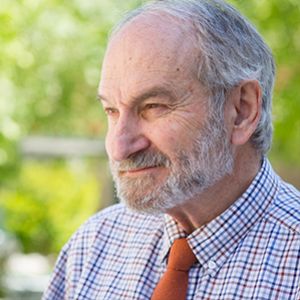
[New Mexico communities] usually know best their priority needs and have a good idea how to address them, but they may not have access to financial or technical assistance resources to address these needs. That’s where the University can play a role.
-Art Kaufman, MD, Distinguished Professor of Family and Community Medicine, The University of New Mexico School of Medicine & Vice President for Community Health, UNM Health Sciences Center
HEROs Who Don’t Wear Capes — or Stethoscopes
While a doctor checks the vital signs of individual patients, a HEROs agent listens to the beating heart of an entire community.
“HEROs are from the community they serve,” said Art Kaufman, MD, a distinguished professor of family and community medicine in the UNM School of Medicine and vice president for community health for the UNM Health Sciences Center. “The community helps identify them. They are trusted and know people and resources in their community. They are local leaders who know the pulse of that community and what resources need to be developed.”
HEROs agents connect UNM’s resources, such as funding and expertise, with problem solvers in local communities to help people overcome barriers to receiving health care. These barriers are typically tied to child care, education, food security, housing, income, racism, safety, social support, transportation, utilities and more. These factors have a much bigger impact on a person’s health than the medical system, Kaufman said.
He also said HEROs work in tandem with community health workers, community health representatives in Tribal communities and learners — a group that includes local high school students who may be interested in health care careers, and health sciences students from UNM, who visit rural communities to learn and work.
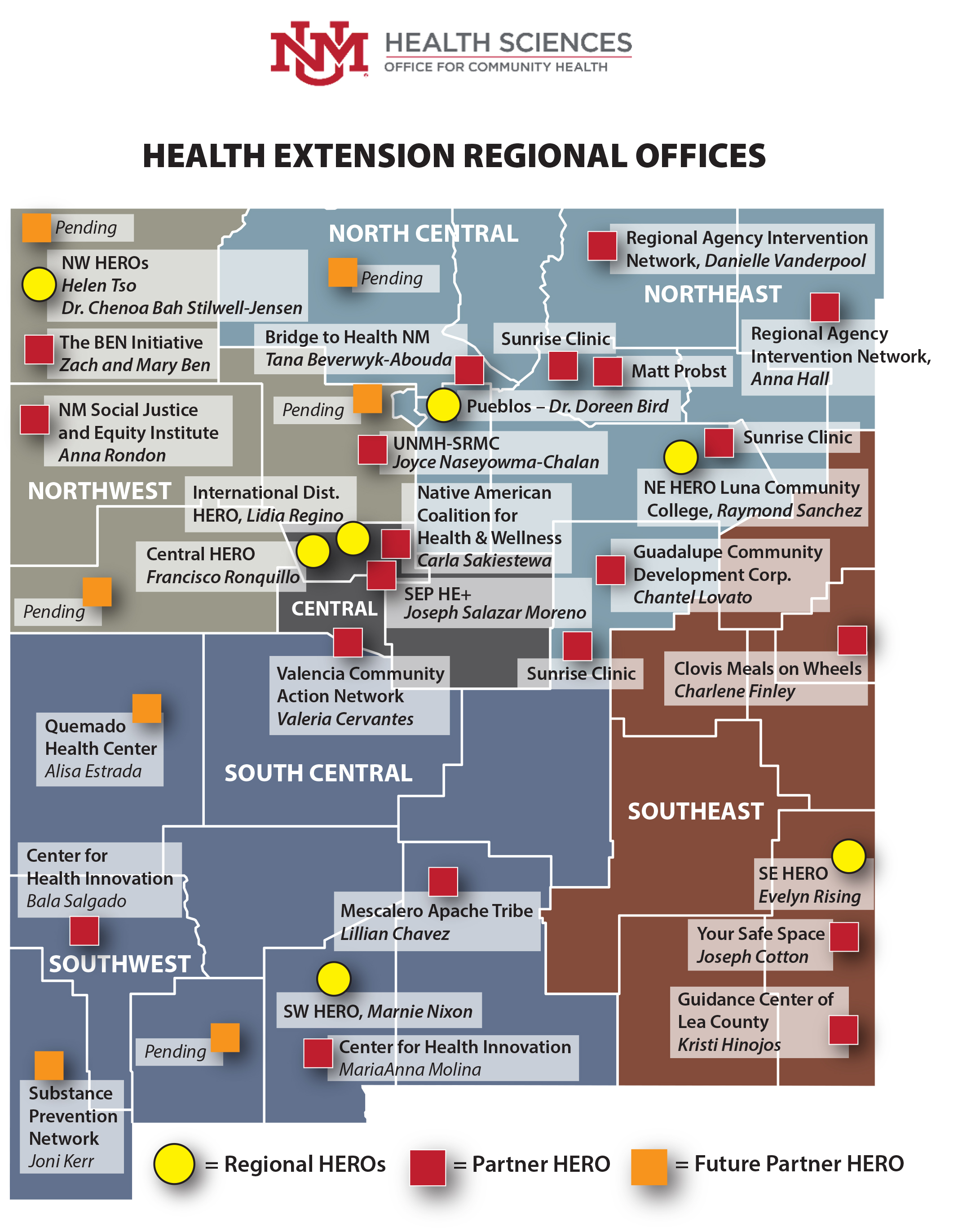
A map of HEROs agents in New Mexico as of July 2025. Image Credit: UNM HEROs Program.
Kaufman said the goal is to create, test and produce sustainable models that will help people overcome barriers to accessing health care and social services, while learning from successful approaches created by other communities.
He added that listening to each community’s needs is essential because communities will not sustain a program that is not their priority.
“They usually know best their priority needs and have a good idea how to address them, but they may not have access to financial or technical assistance resources to address these needs. That’s where the University can play a role,” Kaufman said.
A Partnership to Empower HEROs
Through the partnership with Anchorum, UNM received $330,000 to fund six new partner HEROs — three for New Mexico counties and three for Native American Tribes — and half of the salaries of two full-time Native American regional HEROs, one being Navajo and one being Pueblo. The UNM Office for Community Health will fund the other half of the salaries.
HEROs At a Glance
All HEROs are from the communities in which they serve.
Partner HERO: Partner HEROs are employed outside of UNM. They already do work in their communities, usually for non-profits focused on social drivers of health, which aligns with UNM’s HEROs program. Each partner HERO receives $25,000 per year to free up their time and/or to invest in priority community projects.
Regional HERO: Regional HEROs are full-time UNM employees who cover a large area. They orient and support county and Tribally based partner HEROs; inform policy changes, helping set up programs that don’t exist in the social driver space; and help bridge community needs with UNM resources.
Kaufman said the agreement with Anchorum will benefit several counties in northern New Mexico and the Navajo Nation.
In general, funding the HEROs program is a community effort. Money to do this barrier-breaking work comes from multiple sources, including Medicaid for non-billable services; foundations like Anchorum, JF Maddox and W.K. Kellogg; the UNM Health Sciences Center; and fundraising efforts, which can include government-backed grants, and philanthropic gifts and endowments.
Two Partners in Alignment — and Looking Forward to the Future
Frantz Melio, MD, vice president of health care strategies for Anchorum, said he is optimistic about this new partnership and future projects with UNM.
“I think it’s great,” Melio said. “I think there are massive advantages for both organizations and for the community. I think it’s rare that you find a partnership that is as well-aligned, or that both partners are able to supplement what the other does in such an extraordinary way.”
Kaufman described the agreement as “great” and a “win-win,” due to the close alignment of UNM’s and Anchorum’s goals.
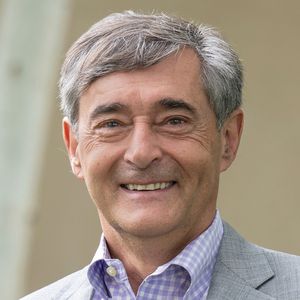
I think this is really exciting. I think it does have the potential of actually making some positive change, and I hope that this is a very longstanding relationship, because that’s what’s needed. These things didn’t occur overnight, and they’re not going to get fixed overnight.
-Frantz Melio, MD, Vice President of Health Care Strategies, Anchorum Health Foundation
Melio noted that UNM and Anchorum have the same vision: to improve health in Tribal, rural and underserved communities in New Mexico by listening to their needs.
“The mission of Anchorum Health Foundation is to positively affect and improve the health of individuals and communities in our service area,” Melio said. “Our service area is basically north of I-40 in New Mexico, and also includes all the Tribal communities.”
Melio also said he can see the partnership with UNM growing.
“I think this is really exciting,” he said. “I think it does have the potential of actually making some positive change, and I hope that this is a very longstanding relationship, because that’s what’s needed. These things didn’t occur overnight, and they’re not going to get fixed overnight.”
Long term, Kaufman said he hopes to see a HEROs agent in every New Mexico county and every Tribal community that wants to participate.
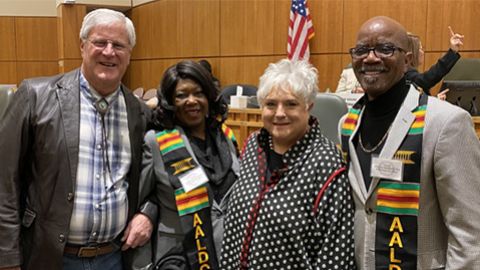
From left: Senator Larry Scott, Evelyn Rising (Lea County HERO), Senator Gay Kernan and Joseph Cotton (Partner HERO from Your Safe Space) participating in African American Day at the New Mexico Legislature. Photo Credit: UNM HEROs Program.
Meeting the Needs of a Diverse State
The HEROs program is important for New Mexico in part because of the state’s large number of rural communities and its population’s racial and ethnic diversity, said Mario Pacheco, MD, associate vice president for community health and director of the HEROs program at UNM.
“We have to be adaptable to the realities of the population, whether it’s urban or rural, whether it’s Hispanic or Native, or whether it’s immigrant or whether it’s highly educated teachers,” he said. “This approach understands and respects the diversity of our state.”
The HEROs program is also important because of New Mexico’s relative lack of financial resources, Pacheco said.
“The other part of it is New Mexico is a very rich state, but we don’t have much money,” he said. “The understanding that we have to make do, sometimes, with less, and put into practice the whole idea of prevention, down the road would serve us well. We have such a high incidence of diabetes, we have such a high incidence of drunk-driving deaths, a lot of things that are just completely preventable and have such high social determinants.”
Pacheco said that, overall, they are looking beyond medical care alone to see what improves community health.
“If we really broaden how we look at health, that’s where we make the progress.”
Thumbnail Image: A scene from Jemez, N.M.


 English (US) ·
  Indonesian (ID) ·