Edited by Brandon Livesay in New York and Lisa Lambert in Washington DC
Tariffs will reach highest rates in nearly 100 years, as Trump shows he's a 'master' at dealspublished at 15:09 British Summer Time
15:09 BST
Natalie Sherman New York business reporter
The tariffs set to start tomorrow revive plans that Trump unveiled in April.
The planned rates, which he presented on posters during an event dubbed "Liberation Day," sparked major market turmoil and threats of
retaliation from trading partners such as Canada and the European Union.
The turbulence has calmed in the months since, even though for many countries there won't be significant differences from Trump's initial plans, regardless of what they have negotiated.
Goods from the European Union, for example, are set to be taxed at 15%. That's only a bit lower than the 20% originally announced, although it is much lower than the 50% Trump threatened at one point.
The UK, the first to announce a "deal" with Trump, accepted tariff rates of 10% on most of its goods, despite having a trade surplus with the US.
All told, the average tariff rate in the US is set to rise to the highest level since the 1930s.
The relatively muted outcry, both in the US and internationally, is a sign of how successful Trump has been at resetting
global expectations of what is acceptable, says Wendy Cutler, vice president at
the Asia Society Policy Institute.
“He’s a master at all of this frankly,” she says.
Image source, Getty Images
More on the South Korea deal: 'We got a bunch of money' says trade adviserpublished at 14:59 British Summer Time
14:59 BST
We just heard from Treasury Secretary Scott Bessent about how the Trump administration reached its tariff deal with South Korea, which was announced on Wednesday. The US said it will charge a 15% tariff on imports from the country, which had been facing a 25% levy after the 1 August deadline.
Now, we're hearing from Donald Trump's trade adviser, Peter Navarro, on the details of the deal.
He tells Fox News: "The South Korea deal, it's kind of built on the Japanese model - we got a bunch of money. The key thing here is shipbuilding. South Korea has a tremendous, tremendous amount of expertise in shipbuilding."
The deal, which will also see Seoul invest $350bn (£264.1bn) in the US, has been touted as a success in South Korea - especially given its record trade surplus of at least $56bn with the US last year.
"If you compare the two economies, South Korea is about half the size of Japan, so that $350bn that we're getting from South Korea is comparable to the $550bn we got from Japan."
More from Treasury Secretary Bessent: Tariff rates could 'boomerang' back to April levelspublished at 14:55 British Summer Time
14:55 BST
Treasury Secretary Scott Bessent also said in his CNBC interview that "rates could boomerang back to the April 2 level".
When Trump first unveiled his slate of new and higher tariffs on "Liberation Day" in April, he showed that some countries faced tariffs at rates never seen before. But Trump then put the rates, many higher than 30%, on pause while the US negotiated deals with trading partners..
Bessent just told CNBC those rates could be put in place for countries who don't reach deals.
He used South Korea as an example of negotiations done well.
"They came in yesterday afternoon, they presented a
very good offer. President Trump moved the offer up a bit, and we reached a
very good agreement, where they will have 15% tariffs," he said.
India negotiations have 'frustrated' Trump, Bessent sayspublished at 14:48 British Summer Time
14:48 BST
Making a deal with India has been a point of frustration for Trump, Treasury Secretary Scott Bessent just told CNBC. He says he doesn't know if a deal with the country will be reached before tomorrow's deadline.
"It will be up to India. India came to the table early.
They've been slow-rolling things so I think that the President, the whole
trade team, is a bit frustrated with them," he said.
Bessent also called out India's buying and refining Russian oil, "so they have not been a great global actor".
Tariffs-eve at the White Housepublished at 14:46 British Summer Time
14:46 BST
Bernd Debusmann Jr Reporting from the White House
Image source, Bernd Debusmann Jr/BBC News
Much of today's focus - globally - is on the rapidly approaching tariff deadline set by President Donald Trump and the White House.
We aren't likely to hear from Trump directly on tariffs until 16:00 EDT (20:00 BST), when he's scheduled to sign an executive order in the Oval Office.
White House officials tell the BBC that the order is focused on bringing back the Presidential Fitness Test, which American public school students had to take until it was scrapped in 2012.
That event, however, is open to today's White House press pool, who will almost certainly throw out a few questions on tariffs.
Additionally, Press Secretary Karoline Leavitt will hold a briefing at 13:00 EDT (18:00BST), which will also likely focus heavily on tariffs - in addition to developments in Gaza.
Another round of tariffs is set to hit. But they might be illegal.published at 14:44 British Summer Time
14:44 BST
The latest round of tariffs is set to start. But there’s a problem
looming over the plan: they may be illegal under US law.
A trade court struck them down earlier this year, siding
with businesses and states, which had argued that Trump did not have the
authority to impose many of his most sweeping tariffs, which he has justified
using a 1970s national emergency law.
That kicked the case to the appeals court, which is set to
hear arguments today.
Businesses say the law does not grant power to tariff, which is traditionally
the responsibility of Congress, and that the US trade deficit is not a national
emergency.
The White House maintains the law gives the president power to regulate
imports – and the president, not courts, decides what counts as an
emergency.
The tariffs were left in place while the case proceeded. It is expected to eventually go to the Supreme Court.
And however the highest court in the land rules, tariffs are likely to stick, even if Trump has to turn to another legal tool.
No major change to New York Stock Exchangepublished at 14:37 British Summer Time
14:37 BST
The New York Stock Exchange has just opened.
Here's what we're seeing as today's bell rings:
NASDAQ Composite: 0.7% up
Dow Jones Industrial Average: No change (0%)
S&P 500 Index: -1%
We're hearing from Trump, with about 14 hours to go until the deadlinepublished at 14:36 British Summer Time
14:36 BST
On the eve of his latest extension expiring, Trump posted on Truth Social several times that his levies on dozens of countries are making America "GREAT & RICH" again.
Here's what else he has said.
On the deadline: 1August, goods from several key trading partners will take effect. Several countries have still not reached agreements that would lighten the levies that Trump plans to charge.
"Now the tide has completely turned, and America has successfully countered this onslaught of Tariffs used against it," Trump says.
On the legal challenges against tariffs: The legality of the tariffs will face a test in a US appeals court today, and Trump posted that his legal team is trying to "save the country".
"If our Country was not able to protect itself by using TARIFFS AGAINST TARIFFS, WE WOULD BE “DEAD,” WITH NO CHANCE OF SURVIVAL OR SUCCESS," Trump writes.
On Canada: Canada has still not reached a trade deal with the US, and after Prime Minister Mark Carney announced plans yesterday to recognise a Palestinian state, Trump expressed discontent, posting, "That will make it very hard for us to make a Trade Deal with them".
On India: The US is set to impose 25% tariffs on India plus an "unspecified penalty" for buying Russian oil and weapons. "I don’t care what India does with Russia. They can take their dead economies down together, for all I care," Trump posted.
From successful Oval Office meeting to uncertain talks - here's what's happening with Canadapublished at 14:30 British Summer Time
14:30 BST
Jessica Murphy BBC News, Toronto
Canada’s prime minister won April’s general election by pitching himself as the leader who could take on the self-styled "Tariff Man" in the White House.
In May, Mark Carney journeyed south to Washington to court the president and formally launch trade and security talks. The PM was praised for his handling of the meeting, despite Trump’s Oval Office references to making Canada the 51st US state.
Leading up to the G7, hosted by Canada in June, word was that the two countries were close to an agreement. At the summit, Trump and Carney met again, and Trump conceded hurdles remained - he's a "tariff person" and Carney "has a more complex idea", he said.
Still, they appeared optimistic and set a late July deadline for a deal.
Canada has since killed a digital services tax that American tech firms opposed, pressed ahead with talks despite Trump’s threats to walk away, and moved the deadline to August. Trump has said he would increase Canada’s baseline tariffs to 35% from 25% and add global tariffs on copper, a major Canadian export.
This month, both Trump and Carney poured cold water on the idea of a quick, tariff-free deal.
“The United States and Canada can do many good things together, we have done that in the past, we can do more in the future, but on fair terms for our country,” Carney said on Monday.
The “complex” talks are at “an intense phase, he said.
Meanwhile, Trump posted on social media on Thursday morning that Canada's plans to recognise a Palestinian state will "make it very hard" to reach a deal.
Image source, Getty Images
How did we get here?published at 14:19 British Summer Time
14:19 BST
Natalie Sherman New York business reporter
Soon after Donald Trump returned to the White House in January, he began raising tariffs, brushing off warnings from economists and businesses about the risks of economic damage.
He started with Mexico, Canada and China, then targeted steel, aluminium and cars, and finally in April, on what he called "Liberation Day", unleashed a blitz of new taxes on goods from countries around the world.
The plans hit trade and roiled financial markets.
But as worries mounted, Trump quickly suspended his most aggressive plans to allow for 90 days of talks.
That original deadline was 9 July, but Trump extended it further to 1 August as the White House looked to strike trade deals.
The administration sent letters warning many world leaders about higher tariffs coming their way.
Now, that deadline is here.
Image source, Getty Images
Deal with China 'not 100% done,' says Treasury Secretarypublished at 13:53 British Summer Time
13:53 BST
Image source, TT/Reuters
US Treasury Secretary Scott Bessent says he's confident a trade deal will be done with China, but adds the deal is "not 100% done".
Speaking on CNBC on Thursday, Bessent says there are still "a few technical details" left on China's side, and that he's talking with President Trump later today.
The secretary also says he's not sure what will happen with trade with India, saying the country has "not been a great global actor", referencing its relationship with Russia.
Trump started hiking tariffs on Chinese goods shortly after his return to the White House. China ultimately responded with tariffs of its own. Tensions escalated,with tariff rates hitting the triple digits, before a trade truce in May.
That left Chinese goods facing an additional 30% tariff compared with the start of the year, with US goods facing a new 10% tariff in China.
The China-US truce has a 12 August deadline, unlike the majority of Trump's tariffs which have a deadline of 1 August.
What are tariffs?published at 13:49 British Summer Time
13:49 BST
Tariffs are taxes charged on goods bought from other countries.
Typically, they are a percentage of a product's value. A 10% tariff means a $10 product has a $1 tax on top - taking the total cost to the importer $11 (£8.35).
Companies that bring foreign goods into the US have to pay the tax to the government. They may pass some or all of the extra cost on to customers.
Firms may also decide to import fewer goods.
Media caption,
What is a tariff?
Clock ticks down to Trump's tariff deadlinepublished at 13:44 British Summer Time
13:44 BST
Brandon Livesay Reporting from New York
Hello and welcome to our live coverage as we follow the twists and turns of global trade ahead of US President Donald Trump's tariff deadline.
The sweeping tariffs will go into effect at 00:01 EDT (05:01BST) Friday.
Trump announced the levies in April, sending chaos rippling through the world economy. But he paused them so countries could negotiate new trade deals.
Many nations do not yet have a deal with the US and face steep tariff percentages when the clock strikes midnight - as high as 50% for Brazil.
Stick with us as we watch for announcements of new deals, how global markets react, and bring you expert analysis on what this all means.

 6 months ago
 Natalie Sherman
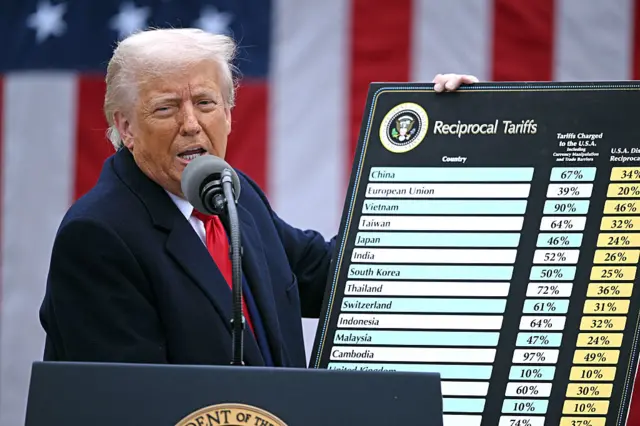 Image source, Getty Images
 Bernd Debusmann Jr
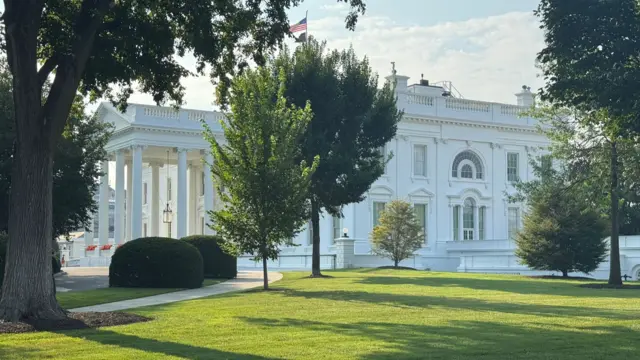 Image source, Bernd Debusmann Jr/BBC News
 Jessica Murphy
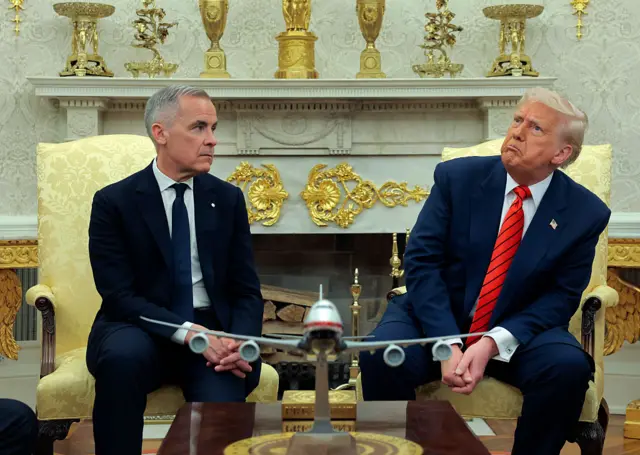 Image source, Getty Images
 Image source, Getty Images
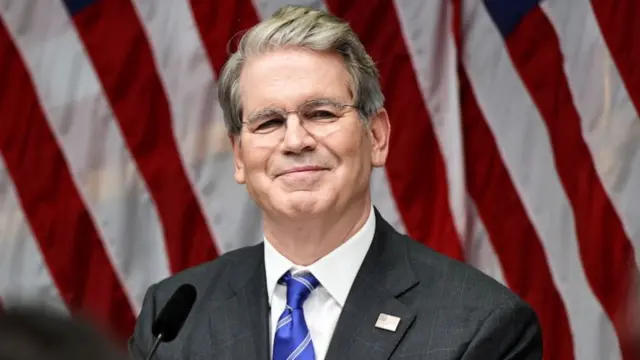 Image source, TT/Reuters
 Brandon Livesay

 English (US) ·
  Indonesian (ID) ·